• Forest for the Trees
  • THE FOREST FOR THE TREES is about writing, publishing and what makes writers tick. This blog is dedicated to the self loathing that afflicts most writers. A community of like-minded malcontents gather here. I post less frequently now, but hopefully with as much vitriol. Please join in! Gluttons for punishment can scroll through the archives.

    If I’ve learned one thing about writers, it’s this: we really are all alone. Thanks for reading. Love, Betsy

The First Time Ever I Saw Your Face*

I have a bad habit. Okay, I have several, but here’s the one I’m most proud of: I think I can tell how somebody writes by looking at their author photo. And basically that’s how I decide which of the Important Books to skip, because really, who has time to read them all? Before you have a freakout about how mean I am, I swear it’s not a beauty contest. It’s more subtle than that. There are some bushy browed dogs out there who still do it for me, who really seem to inhabit their faces the way the voice inhabits the page. I’m looking at you Philip Roth. Not a beauty, but a Dick That Gets the Job Done. Ditto Bukowski, says my friend Sean. Maybe Fran Lebovitz isn’t a conventional beauty, but I like the vibe she gives off in a photo.

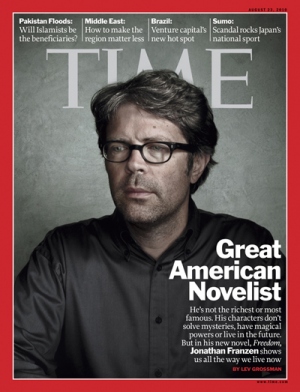
Jonathan Franzen, not so much. I mean, way to man up for the cover of Time, homie. I know he’s America’s Author, but all I see is America’s milquetoast. I suppose he’s conventionally handsome and the article mentions his perfectly tossled hair, but I look at his face and I think of the word limpid. I flash back to how he deprived Oprah’s masses of his gifts on the grounds that he didn’t want to, or something. I see pictures of Jonathan Franzen and I think of all the emo narcies who ever tried to teach me to crochet. Five bucks says he sits down to pee.

This is why I haven’t finished The Corrections and why I’m making it my Life’s Goal to make it through the new novel. I have a feeling it’s a much more rigorous Forrest Gump. Even as I write this I feel that guilty tug of you guys in my ear: You don’t even know what you’re talking about. All the reviews are raves. Read it before you judge. But I’m telling you I’ve already made up my mind.

Botox. I’m not against it. There is a way to use injectables in moderation, so that you still look like you’re made of flesh. But Mary Karr: frozen in bitchface. Can’t read her stuff, don’t like her attitude. I imagine if she were a visual artist, she’d paint in menstrual blood. Her perma-scowl makes me want to pick a fight about the origins of her stupid faith.

For Botox done well, see John Grisham, Jackie Collins and Justin Bieber.

Who can’t you help but loathe on sight?

* Erin Hosier, whose blog style is “on the rag,” is not the same person as Betsy Lerner, whose blog style is “perimenopausal” and on vacation.

I Saw the Movie and I Read the Book

Is that going to be on the exam?

Please take moment, treat yourself to a good laugh, and watch this hilarious book trailer for Gary Shteyngart’s new novel Super Sad True Love Story:

http://www.youtube.com/watch?v=EfzuOu4UIOU

Now, please take out your number two pencil and answer the following questions:

  1. Do you have the new “skill set” for becoming an author?
  2. Have you fully grasped the new technology as the “game changer” for marketing books?
  3. Define the meaning of the word “whore.”
  4. True or false: we are guilty of fetishizing all things Russian: vodka, matryoshka dolls, novelists
  5. The durability of Jay McInerney. Comment.
  6. Mary Gaitskill.
  7. Gary Shteyngart: brilliant buffoon or pretty poseur?

I’m thinking of making a trailer for the revised Forest for the Trees due out in October. I think I’ll start by visiting authors’ graves. Then, I’ll interview James Franco and compare notes about our experience as MFA students. I bet we feel exactly the same way. Then I’ll download something. Then I’ll ask James Franco to join me and August in the hot tub. Would it be too much to ask him to recite The Most of It by Robert Frost? Then we’ll go on a publishing lunch date and pretend to enjoy it. Then we’ll marvel at our iPads. Then we’ll end at Yale where James Franco is teaching. And then we’ll kiss.

What’s gonna be on your book trailer?


Twenty-twenty-twenty four hours to go I wanna be sedated

Dear Betsy:

I just read a review of a new book by Tom Bissell, Extra Lives: Why Video Games Matter . My question: How many bad habits does a memoir need? Judging from the excerpt, nowadays you have to at least spice your memoir with some kind of overuse or abuse of drugs, and this is on top of what looks like overuse or abuse of video games.

Sincerely, Name Withheld

Dear Addict:

As David Carr pointed out in his review of the addict-du-jour memoir, Portrait of the Agent as a Young Addict, we love to watch car wrecks. So I suspect that as long as that is true, and I know I haven’t tired of bending my neck for even a nothing crash on the Merritt Parkway, there will always be room for narratives of self-destruction. When I think of memoirs that felt like game changers (and I am well aware that only assholes use the term ‘game changer’), I think of (in some kind of rough chronology): Anne Frank’s Diary, I Am Third, Papillon, Mommie Dearest, Sybil (not a memoir per se), The Words to Say It, Hope Against Hope, The Thief’s Journal, The Basketball Diaries, Shot in the Heart, The Kiss, Lucky, Autobiography of a Face, A Heartbreaking Work of Staggering Genius, One More Theory of Happiness, Are You There Vodka, It’s Me Chelsea (okay, I haven’t read it but I love the title), and Just Kids.

In my own rich contribution to the genre, I wrote about the crossroads of bi-polar and food issues as the main course. I threw in as side dishes: promiscuity, suicide, shrink rage, prescription drug abuse, hospitalization and an abortion. It sold 16,000 copies. Hardly worth it.

What memoirs rocked your world with or without addictions?


Will You Still Feed Me?

Dear Betsy Lerner, [This letter has been edited down and names removed.]

I’m a 67 yr old woman with a funny, “country” novel I wrote most of 20 or more years ago…I’ve had a career of near misses. Recognition, readings, but only a box of scenes. The divorce and recovery from abusive marriage, illness—there went 10 years or so.

Finally a year ago the MS was ready to send out—and so far, no takers. I should begin by saying I burned through two agents, in the ’90s, both of whom wanted massive changes. Agent X fell in love with the MS, she could even quote from Mama—the character who takes over the book, really—but didn’t want the work of trying to sell it. Literary fiction is a bummer to “package,” I guess. I also no longer have the smashing literary contacts I had twenty years ago. In fact, I’m pretty isolated. Queried 25 agents in the past year (I have an assistant to do the grunt work) — Agent Y and Agent Z requested a full, I gather that’s supposed to be encouraging. My question is, someone with work like this (sample below,) should I be approaching acquiring editors as well? I’m just hell bent on publishing this thing before I croak.
Thank you so much, and for your lovely book as well,
Name Withheld

Dear Writer:
I’m posting your letter because it is similar to seventy-five percent of the letters I receive. I’m going to go through your letter point by point and I’m not going to sugar coat it.

1) You’re asking for advice about what to do, but you really want me to consider the novel. (She follows letter with a pitch and sample pages.) Fair enough. Except, I mostly handle non-fiction. And a “funny, country” novel is not an appealing way to pitch your book. Does country mean that it has a rural setting? Southern? Funny meaning it’s a comic? Like P.G. Wodehouse, or funny like Carl Hiassen? Or Fannie Flagg? If you want to interest me, or most agents, then you need to come up with a better opening line. We’ve talked about this on the blog and here is a perfect example. You could have interested me with a quirky and specific sentence, but instead, you lose me. You should have had me at hello.

2. The near misses we can all relate to. The difficulty in your life very real.

3. It’s not clear if you were writing all that time. Is the book is twenty years old or did it take twenty years to write? I am never eager to read a book that is twenty years old. It sounds stale. If anything say that you worked on it, on and off, for twenty years. We assume rightly or wrongly that an artist gets better over time. I don’t want to see your finger painting; I want to see your masterpiece.

4. Burning through agents makes you sound difficult even if that isn’t necessarily the case.

5.The agent who loved it but didn’t take it on sounds false to me. You might be misinterpreting her meaning because in my experience you take something on when you fall in love. And we’ve talked about this, too, the use of “in love” or “not in love” when talking to books. Some people here feel it’s unprofessional to cast responses in terms of love. Others like it. For me, passion drives everything so I’m okay with saying you love something. I think the real aggravation comes when someone praises a book and then says, but, um, no, not in love. The reason I don’t trust your reading of this agent’s response is because when you are in love, you want to take your clothes off. I know a lot of writers who read more into rejection letters (positively and negatively) than they should. In the end, what difference does it make; it was a no. This post is about getting to yes. People are not interested in close calls, per se, unless they are really exciting.

6. It’s awesome that you have an assistant do the grunt work. I know of a writer who had his assistant send his novel out over thirty times before it got accepted. Yes, it’s famous by now, Mr. John Grisham.

7. The two requests for full manuscripts are extremely encouraging. Is that two out of 25? I often tell people it’s a numbers game. If you get a 10-20% rate of request to send your full from your query: keep going. That’s really encouraging. If the rate is lower than that, work on your letter. If they read the full and pass, you need to get your ass into a writer’s workshop or hire an outside editor to critique and help you with a revision. Some writers don’t want to spend the money (it’s a lot less than an MFA, and it’s a professional investment is how I see it. Think of your writing as a business and make smart investments, and I’m not talking about your computer. Can you buy yourself some time, or feedback — and this can be free from a writer’s group, can you afford Breadloaf or another conference).

8. As for the bucket list: you can go to publishers directly, especially Southern presses might make sense such as Algonquin. You can self-publish. There is nothing to stop you.

Whoa, I apologize for long-winded post. Everyone has their writing and then they have their publishing story. I hope it’s helpful to hear about one case history. Of course, I’m dying to hear yours.

Little Old Lady Got Mutilated Late Last Night

Literary Novelist Turns to Vampires and Finds Pot of Gold

Justin Cronin at an annual book industry convention in New York last week.
Chad Batka for The New York Times — DOESN’T THIS LOOK LIKE A LOT OF FUN??

By JULIE BOSMAN
Published: June 1, 2010

Justin Cronin is the author of an epic, multimillion-dollar, 766-page novel that stars bloodthirsty creatures that run in packs and savagely kill people at night. And he’s planning to turn it into a trilogy.

Dearest darling readers of this blog: Take a moment to read the NYT article about Justin Cronin if you haven’t already. And then tell me, WTF, why isn’t that US? Why aren’t we buying our daughter a pony. Why didn’t we initiate a game “Let’s Plan a Novel Together?” (I actually play this with my daughter all the time but we’ve never gotten past the first few sentences.) Why didn’t we sell film rights to Scott Free Productions with John Logan writing? Why are we not Justin Cronin. And try as I might to hate him and his good fortune, he seems great. Kids, for the umpteenth time: a vampire novel! Please!

What I really want to know, though, is how do these articles make you feel? Hopeful? Inspired? August?

Faces Come Out of the Rain

On the other hand

Hello Betsy,

Thank you for making yourself available for questions. I’ve read conflicting opinions about the following:

Is it a good idea to include a photograph in the bio portion of the book proposal?

Thank you,

Name Withheld

Dear Name Withheld:

No, it is not. I’ve seen quite a few. Everything from 8 x 10 glossy head shots to a guy standing in a motor boat holding a big fish. I’ve seen bikini clad women, candid photos of friends at Hooters, college year book photos, at a lectern giving a speech, you name it. Unless you are a body builder writing about body building, please keep your pecs to yourself. For some reason author photos look amateurish and grasping when they arrive with proposals and manuscripts. How then can it be explained why we love having them inside book jackets?

Another publishing conundrum.

Thanks for writing. Betsy

Sometimes the Lights All Shining on Me

An editor told me that pictures of cute animals increase traffic exponentially. I'm not proud.

If the best moment in an agent’s life is telling a writer that a publisher has made an offer on his or her book, the worse is when, about three weeks after publication, it becomes clear that without an act of god the book is likely to slip beneath the waves. How do you tell a drowning man there’s no raft?

The tour that didn’t materialize, reviews that didn’t appear, feature articles failed to showcase you at your desk, your cocker spaniels aloof on the couch. You had to throw your own publication party and your editor didn’t come. Or your agent for that matter.

I’ve never met an author who didn’t think that publishing a book would change his life. The problem is you never think it’s going to be a change for the worse. Some writers never recover from their book going unnoticed, some can’t take the negative reviews (JDS). Even those who get good attention can get stage fright. Can’t live up to or live down from expectations. And some, just some, can access their gift, harness their desire, and get back to work.

If you have been published, what was it like? Did you get rich, famous, laid? Did you get another contract? Did the book help you in achieving other career goals. Did your father stop calling you a bum? If you have not yet been published, what is your fantasy about what might happen. Don’t be shy.

I’m Not Happy When I Try To Fake It

What was your first literary orgasm? Roger W. Straus, venerable co-founder of FSG, claimed it was The Lovesong of J. Alfred Prufrock. I was always roll the trousers, eat the fuckin’ peach. I’m more of a Four Quartets gal myself. Today, at the psychopharmacologist’s, we were talking about the usual shit meaning my brain and my doctor quoted Eliot’s  “April is the cruelest month.” Well, I’m the cruelest patient and quoting one of the most famous lines of poetry in the world to make a “connection” to me is pathetic. Let’s agree: you won’t quote hideously famous lines of poetry to me (does so much really depend upon a red wheelbarrow?) and I won’t quote the DSM-IV to you.

Let’s get back to literary love. What was the first book that took you prisoner. That changed everything. I’m not saying it made you think that you had to write. Rather, that you could now live. For me, cliched as it sounds, Ariel. First love.

All Because There Was No Driver On the Top

I’ve known authors over the years who balk at boiling down their book to a few sentences. “I”m not good at it,” they cry. I’m sympathetic; it’s extremely difficult to do, and may be impossible when you are in the middle of it. It takes time to figure out what a book is really about, as they are often about so many things. But it’s critical if you want to hook someone. Just imagine yourself at a party. You discover someone writes. You ask, what is your book about? They reply with a five minute plot description. I would guess that by the end of thirty seconds you find yourself wishing you were never born. Now imagine the writer responding, “It’s about a woman who kills her therapist.”

Can you you give me one sentence about your book?

All You Do Is Treat Me Bad

Dear Gap, the advertising slate is pretty full, so please act now!

Dear Betsy,

Did you know…your book, The Forest for the Trees, is out of stock in Australia. Bookstores have to order it from USA. And it has been like that for a few months…it’s not normal, you are losing readers and customers!!

As an author, if you know (from your spy ring around the world) there are public demands for your book, do you have the power to influence your publisher’s decision regarding the distribution of your book?

I know…we only represent a potential of 22 million readers/customers in Australia…it’s not a reason for neglecting us…so, do you mind forwarding my email to your publisher? If it’s not enough we’ll organize a petition. Thanks Betsy.

Dear Nicole Kidman:

This is an outrage. I had heard rumor of a spotty stock situation in NZ and Mumbai, but this is OUTRAGEOUS. What’s worse, come to New Fucking Haven, CT and you won’t find books in the YALE bookstore, the Barnes & Noble near the movies, or at Atticus. My own home town. Every bookstore I’ve ever gone to in the last number of years has not had the book in stock. More galling, every time I stalk the writing shelves (and it can only be described as stalking or skulking), right there in the smack middle of the L’s is Anne Lamott, Bird by Bird, like a poke in the eye. And I really like her book. How then does my darling stay in print if you can never find it, you ask. I believe it’s the internet and piracy. Mostly piracy. But miracle of miracles, I get a check twice a year and it is the sweetest money ever earned. I usually do something fun and kooky with it, like pay my babysitter for a couple of weeks.

Speaking of babysitters, how is Sunday Rose?

Thanks again for the shout out, sister.

Love, Betsy

Where do you get most of your books?